Key Facts
- Case: Montgomery v. Caribe Transport II, LLC, No. 24-1238, 605 U.S. ___ (2026)
- Decided: May 14, 2026
- Vote: 9-0 (unanimous), opinion by Justice Amy Coney Barrett
- Holding: The Federal Aviation Administration Authorization Act (FAAAA) does not preempt state-law negligent-hiring claims against freight brokers. The FAAAA’s safety exception, 49 U.S.C. § 14501(c)(2)(A), saves those claims.
- Practical effect: Freight brokers can be sued in every state for negligently selecting unsafe motor carriers. Federal carrier registration is not a defense.
- Florida precedent: The Florida Second District Court of Appeal reached the same conclusion seven months earlier in Simon v. Coyote Logistics, LLC, No. 2D2023-2775 (Fla. 2d DCA Oct. 22, 2025), a case litigated by The Truck Accident Law Firm.
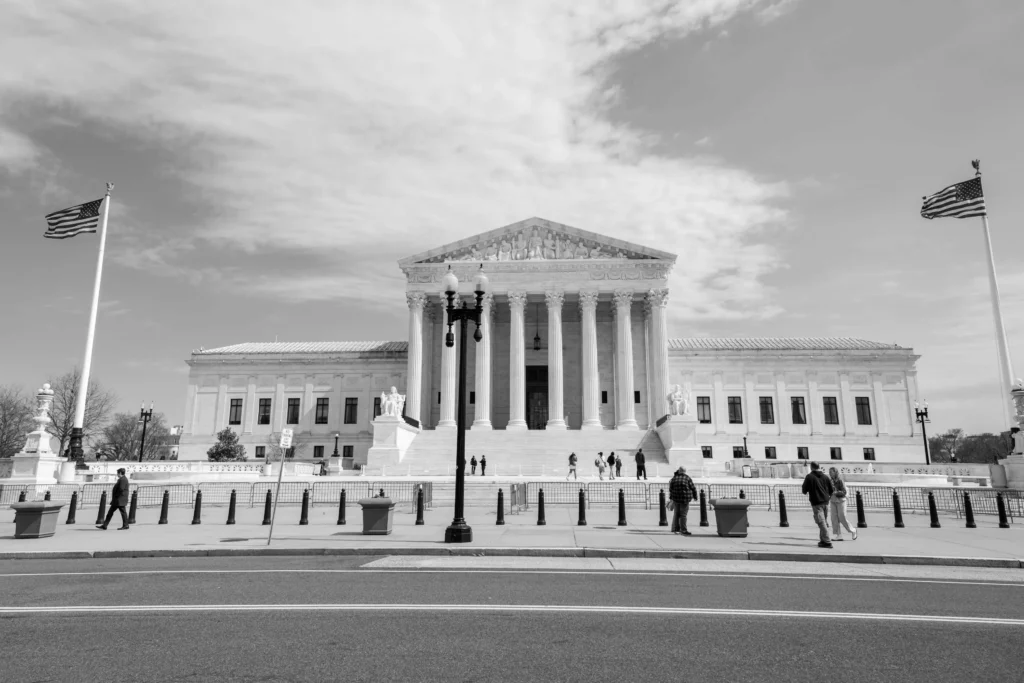
Today the Supreme Court of the United States ended a decade of legal uncertainty about whether freight brokers can be sued when the carriers they hire kill and maim people on American highways.
The answer, 9-0, is yes.
The decision, Montgomery v. Caribe Transport II, LLC, is a turning point for truck-crash victims. It is also a long-overdue piece of accountability for an industry that has spent years arguing it should be functionally immune from the consequences of its own hiring decisions. For families we represent, including the family of our client Matthew Simon, the ruling validates what we’ve been telling Florida courts for two years: a broker who puts an unsafe trucking company on the road owns part of what that trucking company does.
What did the Supreme Court hold in Montgomery v. Caribe Transport II?
Justice Amy Coney Barrett wrote the opinion. The vote was unanimous.
The legal question was whether the Federal Aviation Administration Authorization Act of 1994, a statute that prevents states from regulating the “prices, routes, and services” of trucking and brokerage companies, wipes out state-law claims when a broker negligently hires an unsafe carrier.
The brokerage industry’s position was that it does. Federal law preempts everything, brokers argued, because choosing a carrier is the central “service” a broker provides, and any state-law claim attacking that decision is forbidden interference with a federally deregulated market.
Justice Barrett rejected the argument.
The FAAAA contains a safety exception. Congress was clear when it deregulated the trucking industry that it was not stripping states of their traditional police power to keep dangerous vehicles off the road. The exception preserves “the safety regulatory authority of a State with respect to motor vehicles.” A negligent-hiring claim against a broker, the Court held, fits squarely inside that exception.
In Justice Barrett’s words, a claim is “with respect to motor vehicles” if it “concerns” the vehicles used in transportation. A negligent-hiring claim against a broker who selected an unsafe carrier is unquestionably about the truck that ended up on the highway. The Court rejected as “even odder” any reading that would treat the negligent hiring of an unsafe motor carrier whose truck caused injury as something other than an exercise of state safety authority.
Translation: brokers don’t get to hide behind federal preemption anymore. Not in Illinois. Not in Florida. Not anywhere.
The case behind the ruling: who was Shawn Montgomery?
Shawn Montgomery was severely injured, losing a leg, when a tractor-trailer operated by an Indiana motor carrier struck him on an Illinois interstate. The load had been brokered by C.H. Robinson Worldwide, one of the largest freight brokerages in the country.
The carrier C.H. Robinson chose held a conditional safety rating from the Federal Motor Carrier Safety Administration. That rating is not a paperwork technicality. It means a federal audit found enough deficiencies in the carrier’s safety management to put the rating one step short of “unsatisfactory.” The carrier also had documented driver-qualification deficiencies.
Montgomery sued the carrier and the broker. He alleged that C.H. Robinson knew or should have known the carrier was unsafe and should not have placed that company’s truck on a public highway. The trial court let the claim go forward. The Seventh Circuit reversed, holding the claim was preempted. The Supreme Court took the case and reversed the Seventh Circuit.
The path of the litigation matters because it’s the same path victims have been forced to walk in dozens of jurisdictions for years.
How did freight brokers become so hard to sue? A short litigation history
To understand why today’s decision matters, you have to understand how the brokerage industry built its preemption defense over the past decade.
1994. Congress passes the FAAAA. Modeled on airline deregulation. Aimed at preventing a patchwork of state economic regulation of trucking. Critically, Congress wrote in a safety exception, because no one in 1994 thought they were taking away the states’ authority to protect people from unsafe trucks.
2014 to 2019. The defense bar gets creative. As jury verdicts against trucking companies grew, plaintiffs began naming brokers as defendants when the broker had selected a carrier with obvious safety problems. The defense bar responded by dusting off the FAAAA preemption clause and arguing that any state-law claim against a broker about how it chose a carrier was preempted, because choosing carriers is part of the “service” the broker provides.
2020. Ninth Circuit, Miller v. C.H. Robinson. The first federal circuit to confront the question squarely held that the safety exception saves negligent-hiring claims. C.H. Robinson asked the Supreme Court to review. The Court declined in 2021.
2022 to 2023. The split deepens. The Eleventh Circuit and the Seventh Circuit went the other way. They held that the safety exception is narrow, covering things like vehicle equipment regulations but not common-law tort duties owed by brokers. After those rulings, brokers operating in the Southeast and parts of the Midwest enjoyed near-immunity from negligent-selection claims.
2024. Sixth Circuit, Cox v. Total Quality Logistics. The Sixth Circuit sided with the Ninth. The country was now sharply divided. A crash victim’s ability to hold a broker accountable for hiring an unsafe carrier depended entirely on the state where the crash happened.
October 22, 2025. Florida Second DCA, Simon v. Coyote Logistics. Our case. The first Florida appellate decision to break with the federal preemption side. Reversed a trial-court summary judgment for the broker. The opinion (more on it in a moment) read like a preview of what the Supreme Court would hold today.
May 14, 2026. Montgomery. The Supreme Court adopts the Miller / Cox / Simon approach. Unanimously.
Florida already got this right: Simon v. Coyote Logistics
In the predawn hours of a January morning, Matthew Simon was driving on Interstate 75 in Sarasota County. Ahead of him on the highway was a tractor-trailer moving far below highway speed. The trailer had no functioning taillights, no marker lights, no brake lights, and no conspicuity tape. In the dark, it was effectively invisible. Matthew never had a chance.
The load that trailer was hauling had been arranged by Coyote Logistics, a major freight brokerage. Coyote had handed the load to a motor carrier called Anephna Transport. Anephna had a documented history of safety violations and state and federal regulatory infractions. Anephna also had a habit of doing something the industry calls “double-brokering,” illegally re-selling shipments to other motor carriers, often unvetted, in violation of its contractual obligations. Sure enough, the truck that killed Matthew Simon was being pulled by yet another carrier that Anephna had subcontracted the load to.
Coyote moved for summary judgment on FAAAA preemption. The trial court granted it. In another era — under the Seventh and Eleventh Circuits’ approach — that would have been the end of the case.
We appealed.
On October 22, 2025, the Second District Court of Appeal reversed. Judge Morris Silberman, writing for the court, rejected the idea that a broker can hide behind federal preemption when its carrier-selection decision puts a dangerous truck on a public road. The court was, in Judge Silberman’s words, “not persuaded” by the cases finding preemption, and it rejected “the suggestion that a broker can never be held liable in a negligence case under [the FAAAA]. This position,” the court wrote, “simply does not give sufficient consideration to the safety exception.”
That ruling was, at the time, an outlier. Today it isn’t.
Today the Supreme Court of the United States held what the Florida Second District Court of Appeal held seven months ago. The legal foundation of every defense brief currently arguing FAAAA preemption against a Florida negligent-broker claim collapsed at 10:00 a.m. eastern time on May 14, 2026.
Why broker accountability is a trucking safety issue
The legal news is the headline. The reason the legal news matters is what we want you to leave this article with.
Brokers don’t drive trucks. They sit at desks. They take a load from a shipper, get on a load board, and find a motor carrier willing to haul that load for the lowest possible price by the required deadline. They take a margin off the top. That is the business.
The system would work fine if the cheapest carrier were always a safe carrier. It isn’t.
The carriers that bid lowest on a load are very often carriers cutting corners. They are:
- New authorities under 18 months old, with no track record and no history a broker can review.
- Conditionally rated by FMCSA, meaning a federal audit found significant safety management failures.
- Carriers with elevated percentile scores in FMCSA’s Behavior Analysis and Safety Improvement Categories, particularly Unsafe Driving, Hours-of-Service Compliance, and Vehicle Maintenance.
- Carriers with prior out-of-service orders.
- Chameleon carriers, operations that shut down under one name to escape a bad safety record and reincorporate under another.
- Double-brokers like Anephna in our Simon case, which take loads they were hired to haul and re-sell them to whoever picks up the phone, with no vetting of the carrier that actually shows up.
A broker who wants to know any of this can find out in fifteen minutes. FMCSA’s Safety Measurement System is public. The carrier’s authority status is public. Insurance filings are public. Crash history is searchable. Patterns of double-brokering can be discovered through basic due diligence on the carrier’s operating history.
But in jurisdictions where preemption won, brokers had a structural incentive to know nothing. Vetting created paper trails. Paper trails created discovery. Discovery created liability. The cleanest legal posture was studied ignorance: book the carrier, take the margin, forget the name. If something terrible happened on the highway, preemption was the wall behind which the broker would shelter.
That wall is gone.
What changes for freight brokers after Montgomery
Three things change immediately.
First, brokers can no longer hide behind FMCSA registration. The fact that a carrier has a USDOT number and operating authority means only that the carrier filed paperwork and paid a fee. It is not a safety endorsement. It is not a defense to negligent selection. Brokers who built their entire vetting process around the phrase “they have authority” are exposed.
Second, internal records of carrier selection will be discoverable. Every email, every load-board screenshot, every Slack message about how a carrier was chosen, and whether anyone looked at the carrier’s safety record before choosing it, is fair game. Brokers who relied on willful ignorance now face a discovery process that punishes the absence of records as much as the presence of damning ones.
Third, insurance markets will reprice broker risk. Brokerage E&O and contingent auto policies were priced for a world where most negligent-selection claims got dismissed on preemption. That world ended today. Premiums, retentions, and underwriting questions about vetting practices are about to change sharply.
The brokers who already do the work, who actually pull SMS profiles, verify authority, check insurance limits, watch for double-brokering, and refuse loads to carriers with track records of harm, are not afraid of Montgomery. The ones who built their business on ignorance are.
Can I sue a freight broker after a truck accident?
If you or someone you love has been injured or killed in a crash involving a commercial truck, here is what Montgomery actually changes for you.
You may have a claim against more than just the driver and the motor carrier.
If a freight broker was involved in arranging the load, and on most interstate truckloads one is, you may have a claim against the broker as well. The questions that matter are:
- Who brokered the load?
- What did that broker know — or what should it have known — about the carrier it chose?
- Did that carrier have a conditional safety rating, elevated BASIC scores, prior crashes, or a pattern of double-brokering?
- Did the broker do any vetting at all, or did it just book the cheapest available carrier?
Those questions used to be a dead end in many jurisdictions. They are now live questions in every state.
This is why specialization matters in truck-crash cases. The legal framework, the federal regulations, the FMCSA data sources, and the discoverable industry practices that determine whether a broker is on the hook are not things a general personal-injury practice handles every day. Our firm does only truck cases. We have been litigating broker liability for years. We took Simon through the Second District. We are ready for what is coming next.
Frequently Asked Questions
What is a freight broker, and how is it different from a trucking company? A freight broker arranges the transportation of goods between a shipper and a motor carrier. Brokers don’t own trucks and don’t employ drivers. They make money by matching loads to carriers and taking a margin. A motor carrier — the trucking company — is the one that actually owns the truck and employs the driver.
Can I sue a broker if a truck driver caused my crash? Yes, if the broker negligently selected an unsafe carrier. After today’s Supreme Court decision in Montgomery v. Caribe Transport II, LLC, broker liability claims for negligent hiring of unsafe motor carriers are no longer preempted by federal law in any state.
What is the FAAAA? The Federal Aviation Administration Authorization Act of 1994 is a federal statute that prevents states from regulating the “prices, routes, and services” of motor carriers and freight brokers. It also contains a safety exception that preserves the states’ authority to regulate motor vehicle safety.
What is the FAAAA safety exception? The safety exception, codified at 49 U.S.C. § 14501(c)(2)(A), says the preemption clause does not restrict “the safety regulatory authority of a State with respect to motor vehicles.” In Montgomery, the Supreme Court held that state-law negligent-hiring claims against brokers fall within this exception.
Does Montgomery apply to my case if my crash happened before May 14, 2026? Yes, in most circumstances. Supreme Court decisions interpreting federal statutes apply to pending cases. If your case is open and a broker has raised a FAAAA preemption defense, Montgomery now controls.
What is a “conditional” FMCSA safety rating? A conditional rating means a federal audit found that a motor carrier does not have an adequate safety management system to ensure compliance with federal safety regulations. It is the second-lowest rating and a clear warning sign. A broker hiring a conditionally rated carrier is on notice of that carrier’s safety problems.
What is double-brokering, and why is it dangerous? Double-brokering is when a motor carrier takes a load it was hired to haul and re-sells it to another carrier, usually in violation of its contract with the broker. The danger is that the carrier that actually shows up was never vetted by anyone. The broker does not know who is driving the truck, what that driver’s record is, or whether the carrier is properly insured.
How do I find out who brokered the load that hit me? The bill of lading, the rate confirmation sheet, and the carrier’s dispatch records will identify the broker. So will FMCSA records. An experienced truck-accident attorney can preserve and obtain these records before they are lost, deleted, or overwritten.
Talk to a Specialist Before Memory and Records Fade
After today’s ruling, broker liability is part of the playbook in every serious truck-crash case. But the evidence that proves a broker negligently hired an unsafe carrier is not in any one place. It lives in shipping records, FMCSA databases, internal broker communications, and industry practice. Those records have to be preserved early, before they are lost, deleted, or overwritten.
The Truck Accident Law Firm handles only truck cases. Our co-founders are board certified in Truck Accident Law by the National Board of Trial Advocacy, a credential most attorneys do not hold. We have recovered more than $1 billion for truck-crash victims and their families, and we litigated Simon v. Coyote Logistics through the Florida Second District Court of Appeal, the decision the Supreme Court has now effectively ratified.
If you or someone you love has been hurt in a crash involving a commercial truck, talk to us before you talk to anyone else. There is no fee unless we win.
Call 888-511-TRUCK (888-511-8782) or request a free consultation online.