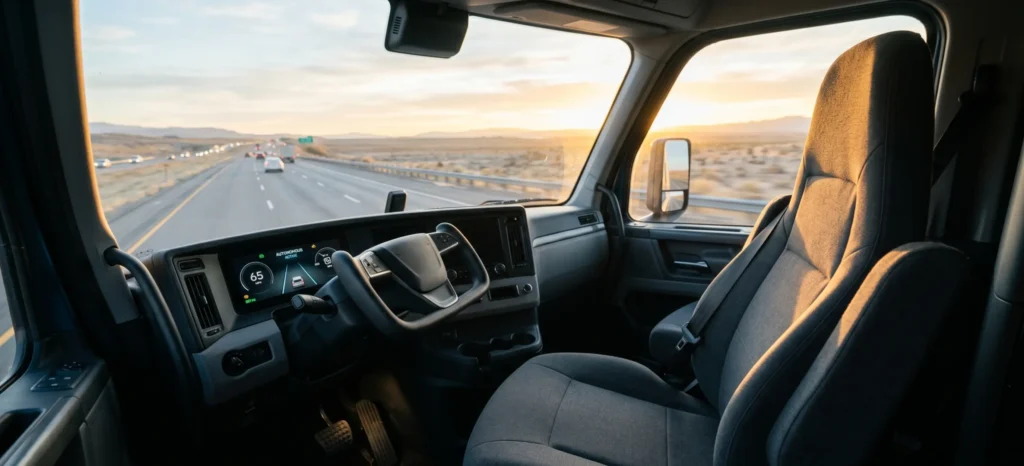
Autonomous technology is moving off the test track and onto public highways. The trucking industry is making an aggressive financial case for it: lower labor costs, round-the-clock utilization, fewer crashes. Much of that math holds up. But the numbers that sell a fleet on going driverless don’t answer the question that matters most after something goes wrong on the road: when an autonomous truck causes a crash, who is responsible?
Here is what the financials actually show, and where they go quiet.
Key takeaways
- Equipping a truck to drive itself costs $125,000 to $150,000 today, projected to fall to $35,000 to $40,000 by 2035 (Goldman Sachs Research).
- Labor is trucking’s biggest expense: driver wages and benefits run close to $1.00 of the $2.26 it costs to operate a truck per mile, about 44% (ATRI).
- Industry studies project autonomous freight could prevent up to 490 deaths a year and add $70 billion to U.S. GDP by 2035, though the leading study was commissioned by an autonomous-trucking company.
- The unsettled question is liability: when a driverless truck causes a crash, responsibility can land on the manufacturer, the software vendor, the fleet, or their insurers, not a driver.
The Up-Front Cost of the Technology
The first cost is acquiring the hardware and converting an 18-wheeler to drive itself. According to Goldman Sachs Research, equipping a truck with autonomous technology in the U.S. currently runs $125,000 to $150,000 per truck. That figure is projected to fall to $35,000 to $40,000 by 2035 as hardware matures and production scales. Goldman projects autonomous trucks will reach cost parity with human-driven ones around 2028.
That is the cost for a single vehicle. For a fleet converting dozens or hundreds of rigs, it adds up fast, which is why the return-on-investment timeline matters as much as the sticker price. One industry ROI analysis puts break-even at 2.5 to 3 years for large fleets on optimized corridors, 3.5 to 4.5 years for mid-size fleets, and 4.5 to 6 years for smaller operators. That is a long runway, and it is a central consideration in any decision to go autonomous rather than stay with a traditional fleet.
Maintenance Runs Deeper
Maintaining an autonomous truck is more involved than servicing a conventional one. It is not just the engine, brakes, and transmission. It requires regular, in-depth diagnostics of the truck’s sensors, cameras, and processors, the systems the vehicle relies on to make split-second decisions a human would otherwise make. Those sensors have to stay clean and calibrated at all times, or the truck’s judgment degrades.
Autonomous trucks also run harder. With no driver who needs rest, they can run through the night and stop only to refuel, which puts more continuous wear on their components. Industry estimates put the added sensor and system maintenance at roughly $8,000 to $15,000 per truck per year beyond what a conventional truck costs to service. The North American Council for Freight Efficiency (NACFE) cautions that whether autonomous maintenance ends up cheaper or more expensive overall is still genuinely uncertain, because specialized system servicing may offset the reduced wear from steadier, computer-controlled driving.
Labor Is the Biggest Line Item
This is where the financial case is strongest. According to the U.S. Bureau of Labor Statistics, the median heavy and tractor-trailer truck driver earned $57,440 per year as of May 2024. But a driver’s base wage understates the real cost of keeping a seat filled. Trucking-cost data compiled by Fleet Equipment puts the all-in cost of a company driver, wages plus benefits, at roughly $77,500 per year.
Looked at per mile, the picture is even clearer. The American Transportation Research Institute (ATRI) found it cost an average of $2.26 per mile to operate a truck in 2024, and driver wages and benefits accounted for close to $1.00 of that, about 44% of the total. Labor is the single largest line item in trucking, which is exactly why removing it is the heart of the industry’s pitch.
Productivity compounds the savings. A property-carrying driver is limited to 11 hours of driving per day under FMCSA hours-of-service rules. A truck has no such limit. It does not get tired and does not need to stop except to refuel, so an autonomous rig can keep moving when a human-driven one is legally parked.
Insurance, Human Error, and a New Kind of Risk
Driver error is a major driver of catastrophic crashes. Delayed reaction times, fatigue, speeding, and poor decisions all raise a fleet’s risk exposure and, with it, its insurance costs. Federal research has long attributed the large majority of crashes to human choices, and removing the human from the cab is the core of the industry’s safety pitch.
But eliminating human error does not eliminate risk. It replaces one kind with another: the autonomous system itself. A self-driving failure may be more predictable than human behavior, but it is no less real, and it raises a harder question than a typical crash does. When an autonomous truck is at fault, who is liable? The cause could be a manufacturing defect, a network outage, a sensor or positioning failure, a software bug, or a cyberattack. Each of those points to a different responsible party, and none of them is the “driver” an injured person would normally look to. We cover this in depth in our guide to who is liable in a self-driving truck accident, and how autonomous trucks are redefining liability for truck accidents in Florida.
This is the part of the ledger the financial models tend to skip. Even NACFE, in its review of the economics, flags insurance and liability as “complex and uncertain” precisely because the question of who answers for a system failure has not been settled. Lower premiums assume someone, somewhere, is accountable when the technology fails. For a person injured by a driverless truck, untangling that accountability across the manufacturer, the software vendor, the fleet, and their insurers is far more complex than a conventional truck accident claim, and the companies on the other side are far better resourced.
The National Picture
At scale, autonomous freight is projected to add meaningfully to the economy. An Aurora-commissioned study by the Steer Group, published in March 2026, projects that an accelerated rollout could account for up to $70 billion of U.S. GDP by 2035, driven largely by higher fleet utilization as driverless rigs run closer to around the clock, which the study estimates could more than double how hard each truck works.
The same study projects public-safety upside: by 2035, self-driving technology could prevent up to 490 fatalities, 8,800 injuries, and 23,000 crashes per year, which it values at roughly $9.4 billion in annual safety benefits, plus about $9 billion a year in household purchasing power as cheaper freight filters down to retail prices. It is worth keeping in mind that this analysis was commissioned by an autonomous-trucking company, so the projections come from a party with a direct stake in the outcome. The underlying mechanism, though, is straightforward: when moving goods gets cheaper, the cost of making and distributing them tends to follow.
The Bottom Line
The financial case for autonomous trucks is real, and it is being made loudly by the companies that stand to profit from it. Lower labor costs, higher utilization, and fewer crashes are genuine prospects, not fantasy.
What the spreadsheets do not resolve is accountability. When a driverless truck kills or injures someone, “the driver was at fault” stops being a usable answer, and liability scatters across manufacturers, software companies, fleets, and their insurers, each with teams built to deflect it. The technology may make the roads safer on average. It will not make the people hurt by its failures any less in need of someone who knows how to find who is responsible and hold them to it.
That is the question we watch most closely as this technology rolls out, and it is the one injured people and their families will be left holding.
Frequently Asked Questions
Who is liable when a self-driving truck causes an accident?
Liability for an autonomous truck crash can fall on several parties: the truck or technology manufacturer, the software developer, the fleet operating the vehicle, or their insurers. Because there is no driver to blame, identifying who is responsible means investigating whether the cause was a product defect, a sensor or software failure, or a cyberattack.
Can you sue the manufacturer of an autonomous truck?
Yes. If a defect in an autonomous truck’s hardware, sensors, or software caused a crash, the manufacturer or technology developer can be held liable under product-liability law. These cases are more complex than typical truck accident claims and often involve multiple companies and well-funded defense teams.
Are autonomous trucks safer than human drivers?
Industry research projects autonomous trucks could prevent up to 490 fatalities, 8,800 injuries, and 23,000 crashes per year by 2035, and federal data attributes most crashes to human error. But autonomous systems add new risks, including sensor failures, software bugs, and cyberattacks, and the leading safety projections come from the companies building the technology.
Will autonomous trucks be cheaper than human-driven trucks?
Goldman Sachs projects autonomous trucks will reach cost parity with human-driven trucks around 2028. Equipping a truck with self-driving technology currently costs $125,000 to $150,000 and is expected to fall to $35,000 to $40,000 by 2035. The largest savings come from eliminating driver labor, trucking’s single biggest operating cost.
If you or someone you love was injured in a crash involving a commercial truck, the rules of who is liable are already complicated, and autonomous technology makes them more so. The Truck Accident Law Firm handles truck cases exclusively, and our co-founders are board certified in truck accident law. Call 888-511-TRUCK (888-511-8782) for a free consultation. You pay nothing unless we win.